The younger Henry Kids: Bertha, Ada, and Willie
Hi there Apollo area history lovers! Last month I came across this passage by Pulitzer Prize-winning author Annie Dillard, who grew up in Pittsburgh and western Pennsylvania. It’s the opening paragraph of her memoir An American Childhood:
When everything else has gone from my brain—the President’s name, the state capitals, the neighborhoods where I lived, and then my own name and what it was on earth I sought, and then at length the faces of my friends, and finally the faces of my family—when all this has dissolved, what will be left, I believe, is topology: The dreaming memory of land as it lay this way and that.
Many of us who grew up in western Pennsylvania have vivid and dreamy memories of lands we navigated in our youth—the places, streets, passageways, trees, waterways, and hideaways in our neighborhoods and how they’re connected. Most of the articles on this Simon Truby website pay tribute to the changing landscapes and generations of people who lived in various places close to the Kiskiminetas River. But really, just about any location, anywhere in the world, has a story to tell if you open your mind and take a close look.
Last-month’s article gave an overview of what happened to widow Mary Jane (Truby) Henry and her kids after the untimely death of Mary Jane’s husband, William Henry Henry, in 1882. Mary Jane is the eldest child of Apollo farmer Simon Truby. Last-month’s story (Part 1) focused on Mary Jane Henry and her first-born son Harry T Henry, who became a steel worker and family man in the new town of Vandergrift, PA.
This month’s article (Part 2) outlines the lives of the three younger children of Mary Jane and William Henry Henry. Their stories take us from Apollo to Blairsville in Indiana County PA, Windber in Somerset County, Salina in Westmoreland County, and even Canton Ohio.
Meanwhile, the Henry homestead at the foot of North Seventh Street in Apollo became divided into three separate properties. Those land sales made way for woman-owned storefronts along Apollo’s main drag on Warren Ave. Later that property in Apollo housed the offices of a somewhat infamous, now-defunct business (for more, see this article).
Today that original Henry property is once again a vacant lot. Who would have guessed that this little plot of land—about a third of an acre—could be the source of so many stories and struggles?
On the trail of Bertha, Ada, and Willie Henry
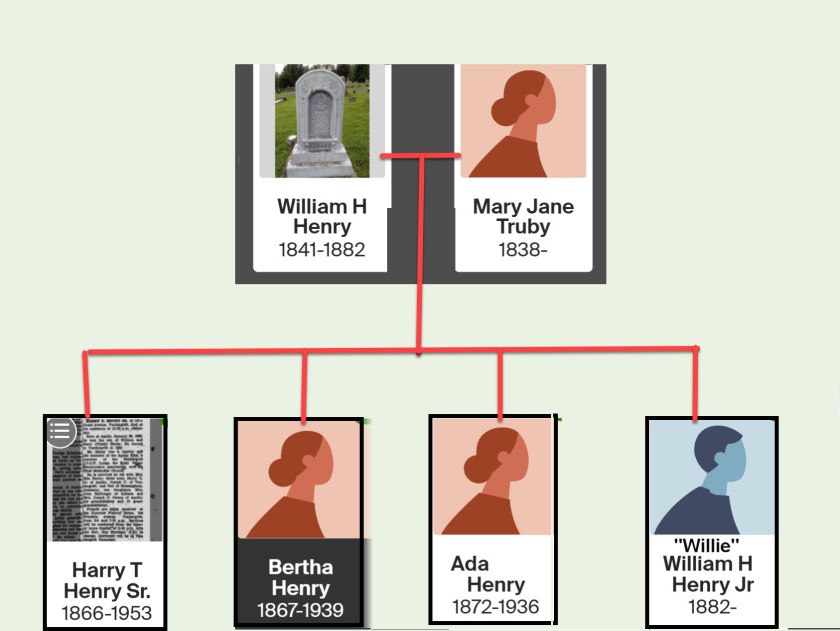
As noted last month (Part 1), first-born child Harry T Henry lived a long and mostly stable life in Vandergrift PA after his father’s death. Many documents can be found that give insights into his life and activities. But it seems less evidence is available about his three younger siblings: Bertha, Ada, and William Henry Jr, known as Willie.
.
Bertha Henry was the eldest of the three. She married at age 22, had several children, and later moved with her family away from the Kiski valley.
Middle child Ada and her brother Willie also married young, but neither had children, and so they’re somewhat like genealogy orphans. By that I mean they’re often overlooked when people are researching their own family trees. There’s a tendency to focus more on one’s own direct lines—like parents, grandparents, and great-grandparents—and not so much on the siblings, aunts, uncles, etc, who certainly were valuable contributors to family activities and dynamics. And that seems a shame.
I think it’s interesting, even fun, to dig in and investigate these heir-adjacent people, who may be left behind on family trees if they lack living descendants. They’re part of the family story, too.
A bit about Bertha
When William Henry Henry died in 1882, his oldest daughter Bertha was 13 years old. Eight years later, at age 21, Bertha Henry married 26-year-old Charles Morford (1864-1940), who seemed to be a stand-up guy.
Charles Morford grew up in Blairsville, Indiana County PA, with his parents Stephen and Ruhana Morford. After his dad’s death, 16-year-old Charles Morford got a job handling luggage for the Pennsylvania Railroad. His income supported both his widowed mom and his two older, unemployed sisters.
A few years later, in July 1886, Charles got promoted to a more lucrative position as a ticket agent in Apollo PA, where his salary rose to $92 per month. His move to Apollo was perhaps destiny. That’s where he met blue-eyed Bertha Henry, who lived with her siblings on the Henry homestead at the foot of North Seventh Street in Apollo. Charles and Bertha married at Apollo Methodist Church on May 28, 1890. Their first child, Donald L Morford, was born in Apollo in 1891, followed by daughter Fay Morford in 1892 and another son, Clyde, in 1894.
Like all families, Bertha and Charles Morford had their ups and downs. An infant son died in July 1896, six years into their marriage. Another child, Helen, was born with a developmental disorder, and she lived with her parents until their deaths. And first-born daughter, Fay, gave birth to a child out of wedlock at age 21, so Bertha and Charles Morford raised the newborn baby, Dorothy, as their own. Fay later married Irish immigrant Francis Mulcahy, and they raised their own family. Fay went on to become a justice of the peace in Somerset County, PA. And it seems that Fay and Dorothy always interacted as sisters and never as mother and daughter.
The Henry/Morford family later relocated to Black Lick Township in Indiana County PA, where Charles managed the railroad office. And the local papers reported on the many times that Bertha Henry Morford traveled back to Apollo to visit friends and family, and vice versa.
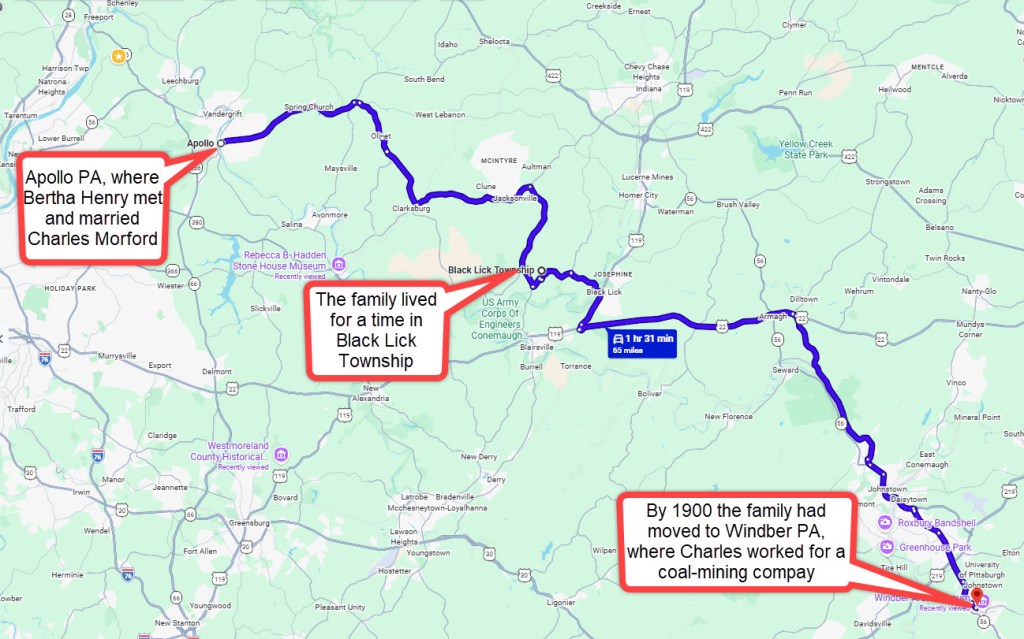
Bertha Henry Morford and her family moved from Apollo PA to Black Lick Township in Indiana County and later to Windber in Somerset County. The family likely traveled by train, since Charles Morford worked for the Pennsylvania Railroad. With today’s cars and roads, a trip from Apollo to Black Lick and then Windber would take about an hour and a half.
By 1900, Charles Morford seemed ready for a job change. His years of railroad work positioned him well for a job as a weighmaster or weigh boss in regional coal mines. Weighmaster jobs involved careful record-keeping and weighing of coal-filled train cars—an important function since miners were often paid by the weight of coal they extracted.
Charles and Bertha Morford moved their family to the newly formed coal town of Windber in Somerset County, somewhat near Johnstown PA. And Charles Morford began working as weighmaster for the Berwind-White Coal-Mining Company.
The coal mines in Windber became infamous for harsh working and living conditions, which led to extended strikes and efforts to unionize in the early 1900s. There was an influx of immigrant labor (mostly Slovak, Hungarian, Italian, and Polish) and deadly clashes with company guards.
Weighmasters like Charles Morford were in the thick of things, since mine workers maintained that the company’s weighing system was “grossly dishonest,” among many other grievances. You can read more about the worker strikes in Windber at the Indiana University of Pennsylvania (IUP) library, which has extensive info about the history of Pennsylvania coal-mining, including Windber.
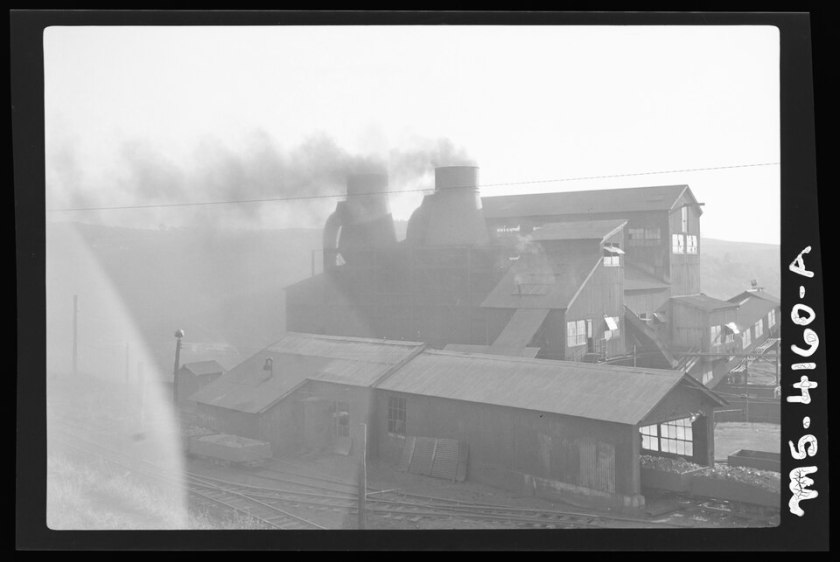
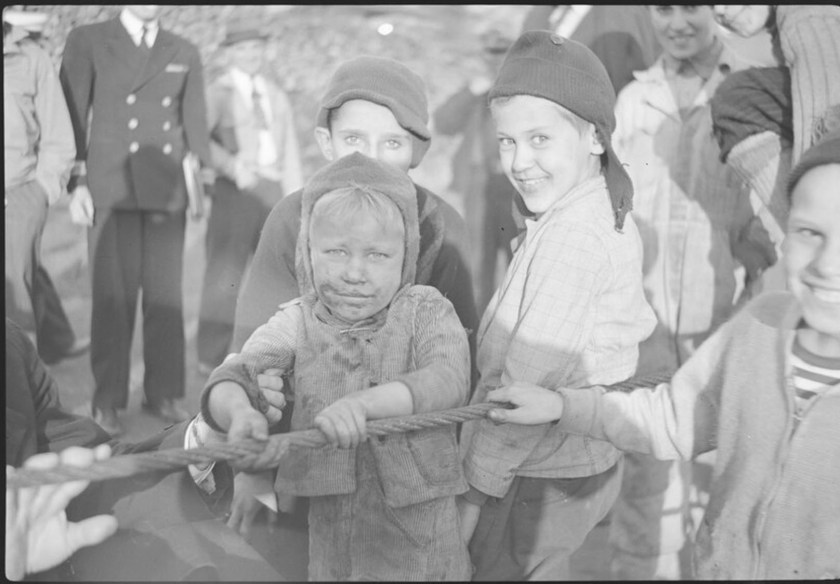
Workers living in company housing at the Berwind-White Coal Mining Company complained about harmful smoke entering their homes at all hours, from day to night. Top photo shows Eureka #37 Mine in Windber PA. Bottom photo shows miners’ children in 1946. Photos courtesy Wikimedia Commons and National Archives.
We don’t know what Charles and Bertha Morford thought about the strikes and efforts to unionize. But we do know that Charles spent the rest of his life—nearly 40 years—working for the coal-mining company in Windber as a weighmaster or weigh boss, and later as a night watchman. His sons Donald and Clyde also ended up working for the Berwind-White Coal-Mining Company. All three of these men raised families, and all three were life-long renters, never owning a home.
Bertha Henry Morford died at age 72, on December 10, 1939, in Windber PA. Her husband Charles died the following year, at age 76. They’re buried together in the Forest Lawn Memorial Park in Cambria County, Pennsylvania.
A bit about Ada
If you were to walk or ride your bike along the Roaring Run Trail—from the trailhead parking lot along Canal Road in Apollo to the trail’s end 5 miles later in the village of Edmon—you’d be very near to the little village of Salina, which is on the other side of the Kiskiminetas River, in Westmoreland County. I can’t say for sure that I’ve ever been to Salina, but I do hope to visit someday soon. Salina is where Ada Henry spent much of her adult life.
Ada Henry was the youngest daughter in the Henry/Truby family. She was about 11 years old when her father William Henry Henry died in 1882. And she was around age 20 when she married a Mr. Edward Younkins in late 1891. The marriage was brief, lasting less than a decade, but details are hard to find. I found no marriage, death, or divorce records that fit the bill. The only evidence I found of Ada’s union with Edward Younkins comes from Armstrong County court records created during the settlement of farmer Simon Truby’s estate, after his death in 1886.
Ada Henry’s second marriage was to a farmer and coal-miner named John Ringer Fennell (1853-1935), sometimes called J R Fennell. He lived in Bell Township, Westmoreland County, just across the river from Apollo.
J R Fennell was 20 years older than Ada, and this was likewise his second marriage. He divorced his first wife, Susan Emma Johnston, in 1901 (news item appeared in the Ligonier Echo on March 27, 1901). J R and his first wife had at least five children, the oldest of whom was about the same age as Ada Henry. That is, Ada was young enough to be J R Fennel’s daughter.
Ada Henry and J R Fennell had married by 1905. That’s when his name first appears in court records related to Simon Truby’s estate.
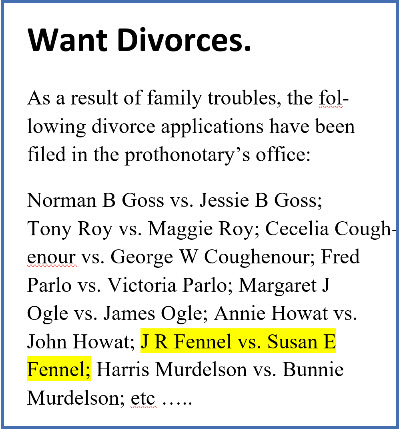
Salt was a big industry along the Kiski River back in the early 1800s. But by around 1850, local salt wells had become contaminated with petroleum. So salt-dependent communities like Salina and Saltsburg shifted to new industries. The village of Salina turned to brick-making, which also required clay- and coal-mining. J R Fennell and many members of his family ended up working for the Kier Fire and Brick Company in Salina, later known as General Refractories in the 1930s.
The brickyard was originally owned by industrialist Samuel M Kier of Pittsburgh. After his death his widow Elizabeth Kier laid out a planned community in Salina, including dozens of lots for worker housing, a town hall, school, and hotel.
In 1908, J R Fennell was among the first to purchase a residential lot that was company housing in the Elizabeth Kier Plan. It was Lot number 40 in the plan book, which today is at 334 Stewart Street in Salina. By 1910, J R and Ada Henry Fennell owned their Salina home outright. They lived in their home on Stewart Street for most of their remaining years.
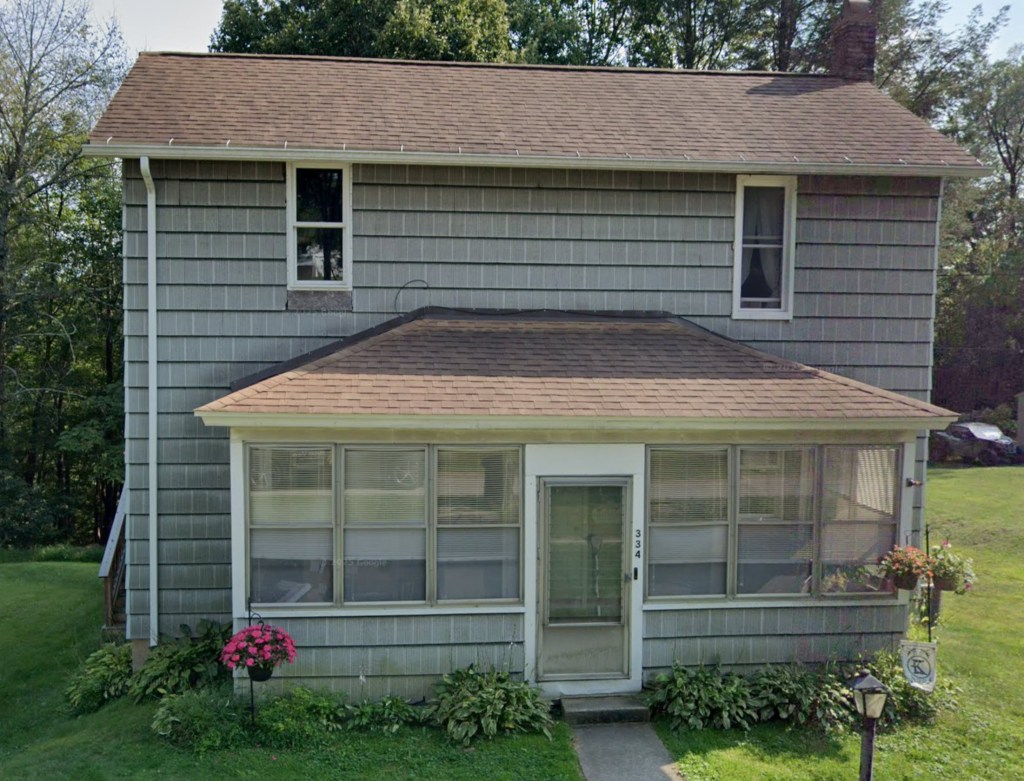
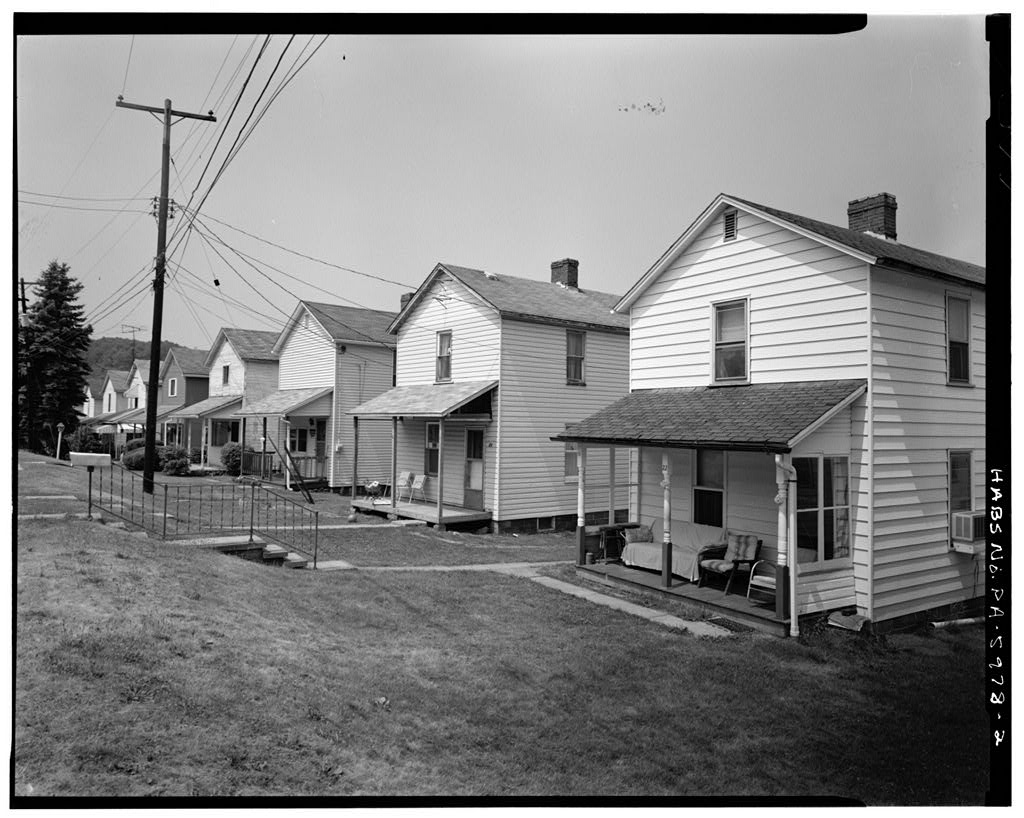
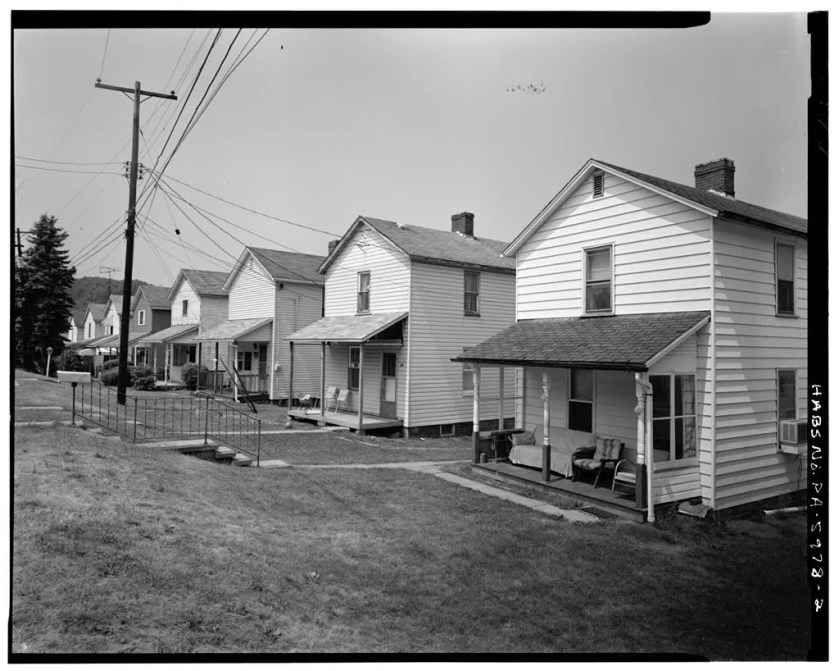
First photo shows the house at 334 Stewart Street in Salina, also called Lot 40 in the Elizabeth Kier plan of lots. The home was originally owned by John R Fennell and his wife Ada Henry Fennell.
Second photo shows some of the 20 near-identical houses built on this part of Stewart Street, locally known as “Twenty Row.” These homes in the Elizabeth Kier plan were a little bigger and nicer than earlier worker housing in Salina. Back in the 1980s and 90s, the U.S. Federal Government did a survey of historic American buildings and towns, including Salina. You can see more photos of Salina from that survey at the Library of Congress.
Although Ada and J R Fennell had no children together, some of J R’s adult children stayed in the area, and of course they endured many highs and lows like most families. In one tragic case, J R Fennel’s 23-year-old daughter, Carrie A Carnahan, died after being thrown from a carriage by a runaway mule team in May 1909. Her 4-year-old daughter Beatrice was also thrown from the carriage but survived. Carrie Carnahan’s funeral in Salina was so crowded that many had to stand outside during the services. The Saltsburg Press noted that her husband had “extreme sympathy” from the community, since in the past year he had endured the loss of not only his wife but also two children.
In happier news, J R Fennel’s eldest son, James Sylvester Fennell, married in 1900, had five children, and became a much-beloved postmaster in Salina. In 1935, as J R’s health was declining, he and Ada sold their home on Stewart Street to his son James for one dollar.
But back to sadder news …. shortly thereafter, J R and Ada Fennell moved into the Westmoreland County Home in Greensburg PA. It was a county-run institution that that housed the vulnerable elderly, indigent adults, and people with chronic illness. J R Fennell had been diagnosed with senile dementia, and he died on May 15, 1935, at age 82.
His wife Ada Henry Fennell died the following year, at age 59, with an unusual diagnosis of encephalitis lethargica, sometimes called epidemic encephalitis. This poorly understood condition spread widely around the world from about 1919 to the 1930s. Encephalitis lethargica can cause behavior changes, extreme sleepiness and insomnia, twitchiness, mania, and locking up of muscles. It sometimes leads to Parkinson’s disease. Today it’s considered a rare disorder.
Ada Henry Fennell died from encephalitis lethargica on January 22, 1936. She and J R Fennell are buried together at West View Cemetery in Avonmore, PA, along with other members of the Fennell family.
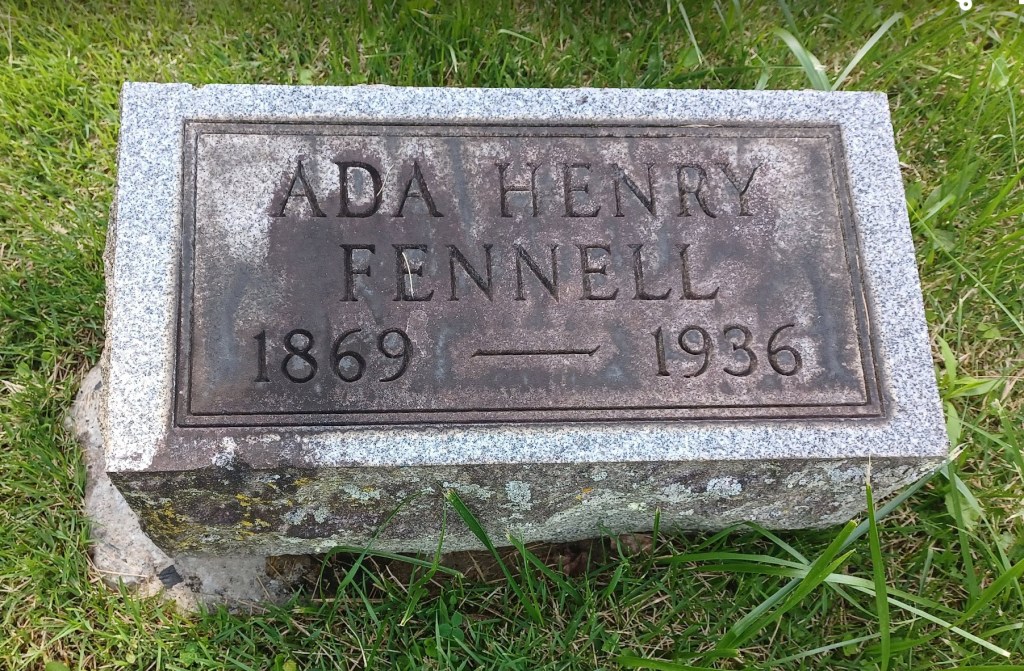
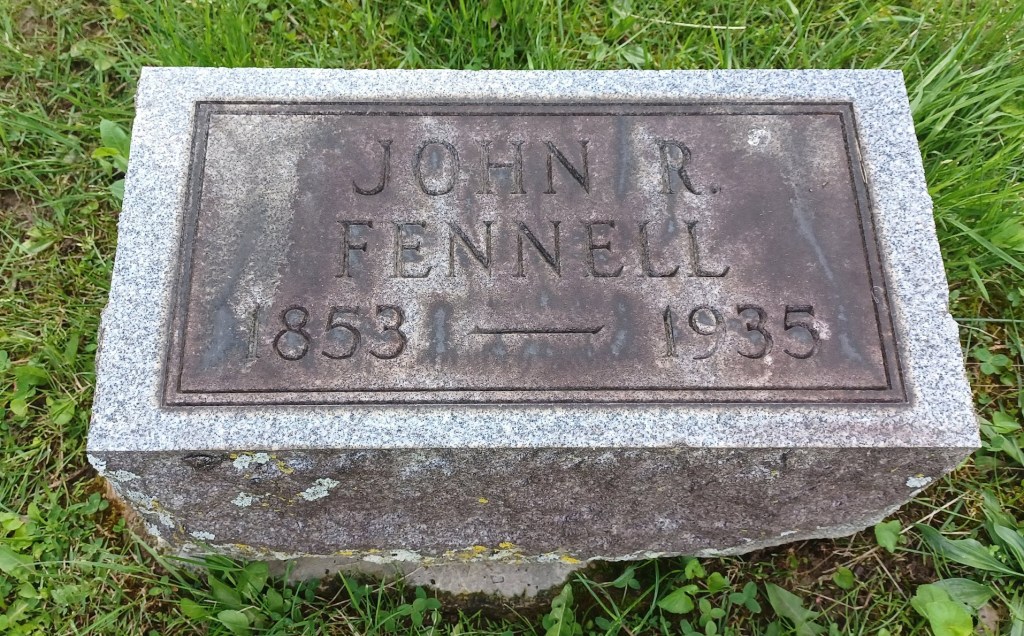
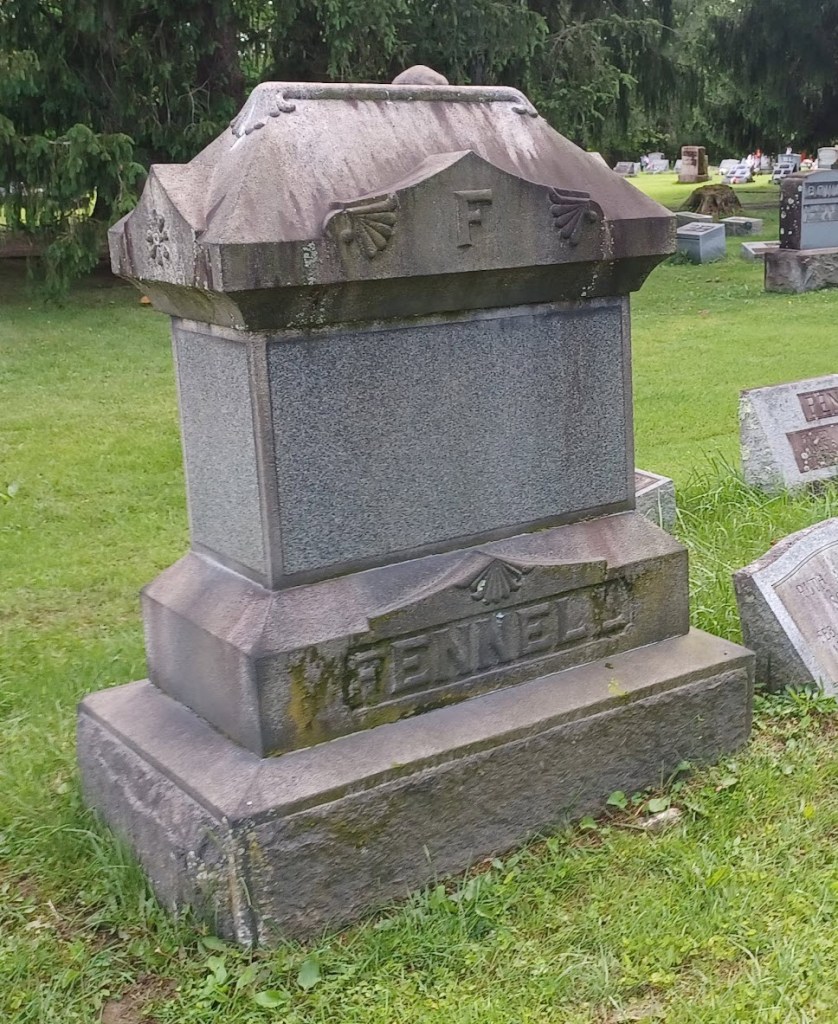
Ada Henry and J R Fennell graves in West View Cemetery, Avonmore PA. Photos by Vicki Contie, 2026
Willie, the oft-forgotten namesake
When researching the Henry/Truby family, it can be easy to overlook little Willie, the youngest of the Henry siblings. Formally known William H Henry Jr, Willie was only about two months old when his father William Henry Henry died by suicide in 1882. Because of his young age, Willie was often under the guardianship of his older brother Harry T Henry, especially during the processing of their grandfather farmer Simon Truby’s estate.
Unfortunately, clues about Willie Henry’s life are scarce. His name appears in only one federal census—the one in 1900.
By 1900, when Willie was 18 years old, all three of his siblings had married and moved away from Apollo. So Willie Henry moved in with his widowed aunt Belle Truby Carpenter, who was living on North 6th Street in Apollo, along with her 13-year-old son Charles. Willie Henry contributed to the family’s finances by working in a local print shop.
In a case of kismet—or maybe it is that proximity breeds familiarity—it so happens that in 1900, Belle Henry’s immediate neighbors were 80-year-old Samuel S Jack Sr; his new wife Kate, nearly half his age; and Kate’s 16-year-old precocious daughter Mary White, who was working as an insurance agent.
Being quite neighborly, teenage Mary White met Willie Henry. The two courted and were married on September 24, 1902. They both were still considered minors—Willie was then 20, and Mary 18. So they needed signed permission from Willie’s guardian (his older brother Harry T Henry) and Mary’s mother Kate Jack.
Unfortunately, I’ve lost track of Willie Henry after that. Court records related to Simon Truby’s estate indicate that Willie Henry must have died by June 1905, about 3 years after the marriage, because estate documents began referring to “Mary W Henry, widow of Will H Henry late of Apollo.” But I haven’t been able to learn more about Willy Henry’s fate. Ive found no matching death records or related documents.
But census records show by 1920, Willie’s widow Mary White Henry had moved with her mother to Mahoning Road NE in Canton Ohio, where Mary worked in a bank. In a very strange coincidence, the 1920 Census page that has info about widow Mary White Henry also includes info about my own Contie family, who were living on the same Mahoning Road in Canton Ohio, including my great-grandfather Ben Contie and my grandfather Joseph Contie. In fact, their two homes were just 350 feet from each other, or a 1 minute walk. Today neither home still exists. I wonder if my Contie family might have been acquainted with the widow Mary Henry and her mom on Mahoning Road?
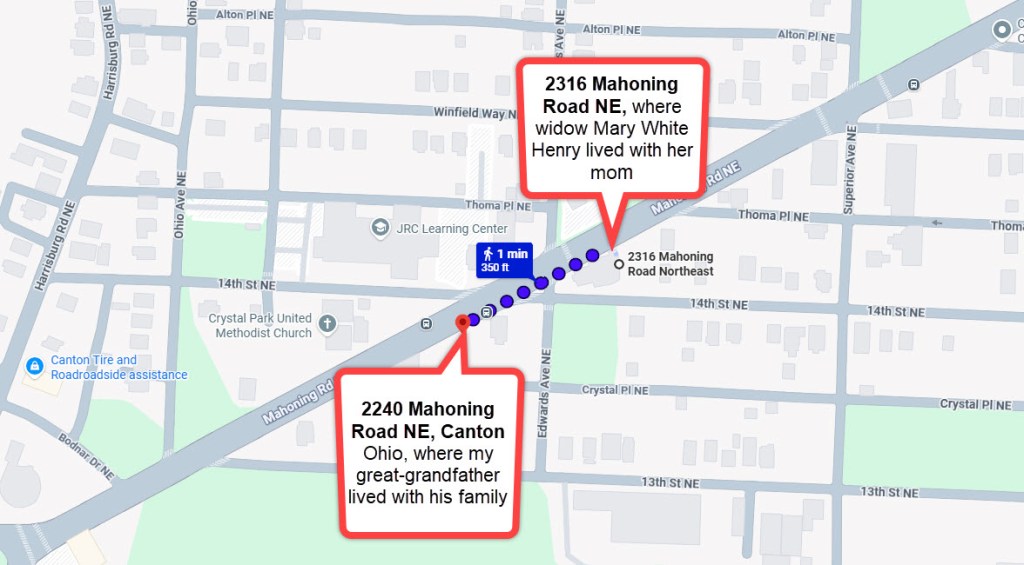
By 1920 Mary White Henry had moved to Canton Ohio with her mom. And by coincidence, my great-grandfather Ben Contie was with his living with his family (including my grandfather Joe) on the same road, just a minute’s walk away. Ben Contie had been a stone mason in Venice Italy, and by 1910 he was living in Vandergrift PA. When the Contie family moved to Canton, Ben and Joe were working as bricklayers. By 1930 the Contie family had returned to Vandergrift. Such an odd coincidence.
Widow Mary White Henry was still working as a bookkeeper in a bank when her mom Kate Jack passed away in 1931. Mary then had a late-in-life marriage, at age 60, to Edgar Everett Swinehart of Canton, who was a banking and real estate professional. It seems like a happy development for the long-time widow. Mary White Henry Swinehart passed away in Canton Ohio in 1979. She had no children of her own, although she did have Swinehart step-children.
A summing up
That ends my summing up of the family of Simon Truby’s first-born child, Mary Jane Truby, and her husband William Henry Henry. The Truby and Henry families are very complex, as are the Fennell and Jack families. Given names are often used over and over, across generations, so it’s easy to get mixed up about who’s who. I try to double and triple check all the information in these stories. But still, mistakes can be made. Feedback and corrections always welcome.
Speaking of mistakes, the many county histories published in Pennsylvania in the late 1800s and early 1900s can give you some nice clues, but they’re not always accurate. For instance, Boucher’s History of Westmoreland County, published in 1906, states that Ada Henry had married a William Fennell of Salina. So I looked him up and found that there was indeed a Dr William Fennell in Salina, but his wife was named Ilda L Fennell and not Ada, as Boucher’s book claims.
It turns out, Ada Henry had married Dr William Fennell’s brother, John Ringer Fennell, often called J R Fennell, which I learned by looking at Simon Truby’s probate records. For added confusion, William and J R Fennell had a brother named George, and his wife was also named Ada Fennell, but that Ada often called herself Ada E Fennell. Still, it’s hard to keep things straight. And county histories can send genealogists down some wrong paths.
Which is a long way of saying, you can’t always trust the information you see in county histories or biographies. These books can provide clues, but it’s best to verify the details via other sources.
I’m likewise suspicious of AI. I tried asking AI for a few leads, and I found that the info provided was often spotty, only partly correct, or just plain wrong. I guess I’m not a fan, at least for now. Admittedly, I haven’t taken the time to better learn how to use AI. And I never use AI for writing.
Thank you for reading this history of the Truby/Henry family. Feedback appreciated. And wishing you all a happy November and Thanksgiving!
Oh, here’s something we can all be thankful for: Our regional historical societies, like the Apollo Area Historical Society, the Saltsburg Stone House Museum, and the Westmoreland County Historical Society Please consider joining, volunteering your time, or sending monetary donations to these important organizations. Cheers!
© 2026 Vicki Contie. All rights reserved

