How Mary Jane Truby’s kids bounced back
It’s a summer day in June, 1882. Mary Jane (Truby) Henry, the eldest child of Apollo farmer Simon Truby, is at home in Leechburg, Pennsylvania, with her four children. Her youngest is an infant, just two months old. Her oldest child is 15 and working as a store clerk.
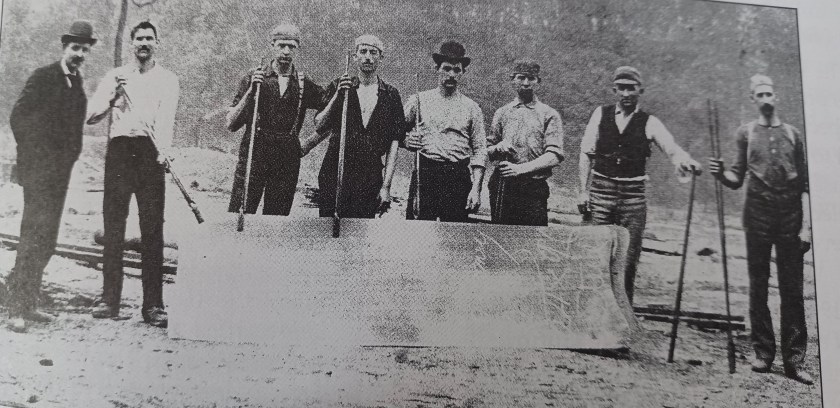
In recent days Mary Jane’s husband, William Henry Henry, has been unusually distraught. He’s a muck roller in the Leechburg mills. But lately he’s been spending a lot of time at the nearby home of his brother-in-law, Lewis Bowers, who is gravely ill. Twenty years earlier, Bowers and Henry both fought in the Civil War, with Henry having served in the 78th Regiment of the Pennsylvania Infantry.
William Henry Henry spends a long night at Bowers’ presumed deathbed. Then he returns home to Mary Jane and heads upstairs for a nap. Around supper time, Mary Jane asks her son Harry to go waken his father for dinner. But the boy returns alone, saying his father won’t wake up. When Mary Jane climbs the stairs, she finds her husband has killed himself.
And so in an instant, Mary Jane Henry’s world is utterly transformed. She is now a widow, the head of her family’s household, and the object of public scrutiny. She is suddenly responsible for family finances, and she has four children to care for, including an infant son. The details of her husband’s suicide were widely covered by the local newspapers, which must have been traumatizing to both her and her children.
Long-time readers of this Simon Truby website may recall that I wrote a story about Simon’s eldest child, Mary Jane Truby, about nine years ago. That story ended with her husband’s tragic death. (You can read that earlier story here.) Back then, I wondered and even worried about widow Mary Jane and her four children, and how they fared after their patriarch’s tragic death. And I promised to dig up and share more info about their fates.
Well, it’s been a while—quite a while—but promises made, promises kept! In doing this follow-up research, I even uncovered a few details about this branch of the Henry family that may be missing from many Henry trees on Ancestry and elsewhere. I also took a deep dive into the family’s property sales, which introduces a few stories about other Apollo-area families.
As always, if local history buffs or family descendants notice any errors in my evidence or conclusions, please do let me know so I can add corrections to the website. The Henry family of Armstrong and Westmoreland counties is complex and can be difficult to detangle!
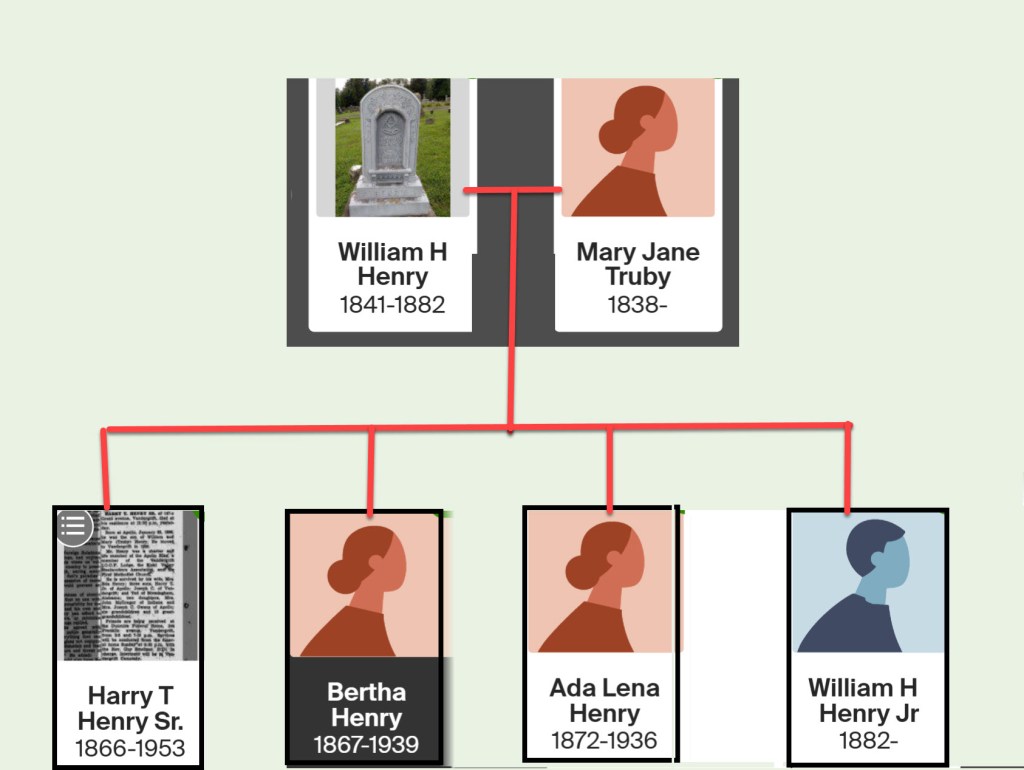
At the time of William Henry’s death, his children were: Harry T Henry, age 15 (the “T” stands for Truby); Bertha, age 13; Ada, age 11; and baby William Henry Henry Jr, or Willie for short.
Unlocking the mysteries of mom Mary Jane
Among Simon Truby’s nine children, Mary Jane Truby was the first to marry and the first to be widowed, raising her children alone after the death of her husband. But where was she buried and when did she die? It’s been hard to pinpoint these and other key details about her life. It seems she wasn’t interred next to her husband in the old Apollo Cemetery—or at least, there is no grave marker for her there. But some clues about her later life and death can be found elsewhere, in courthouse records.
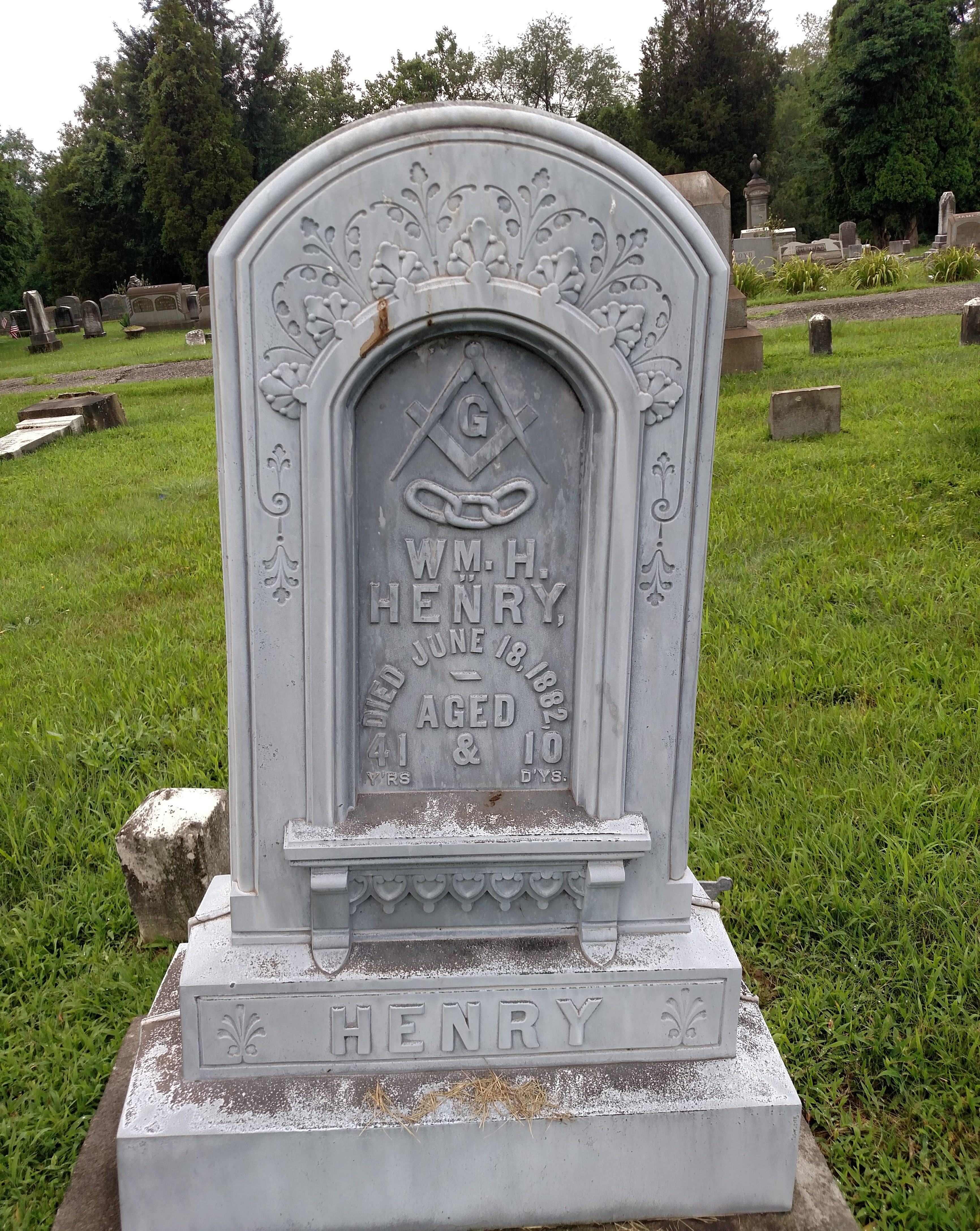
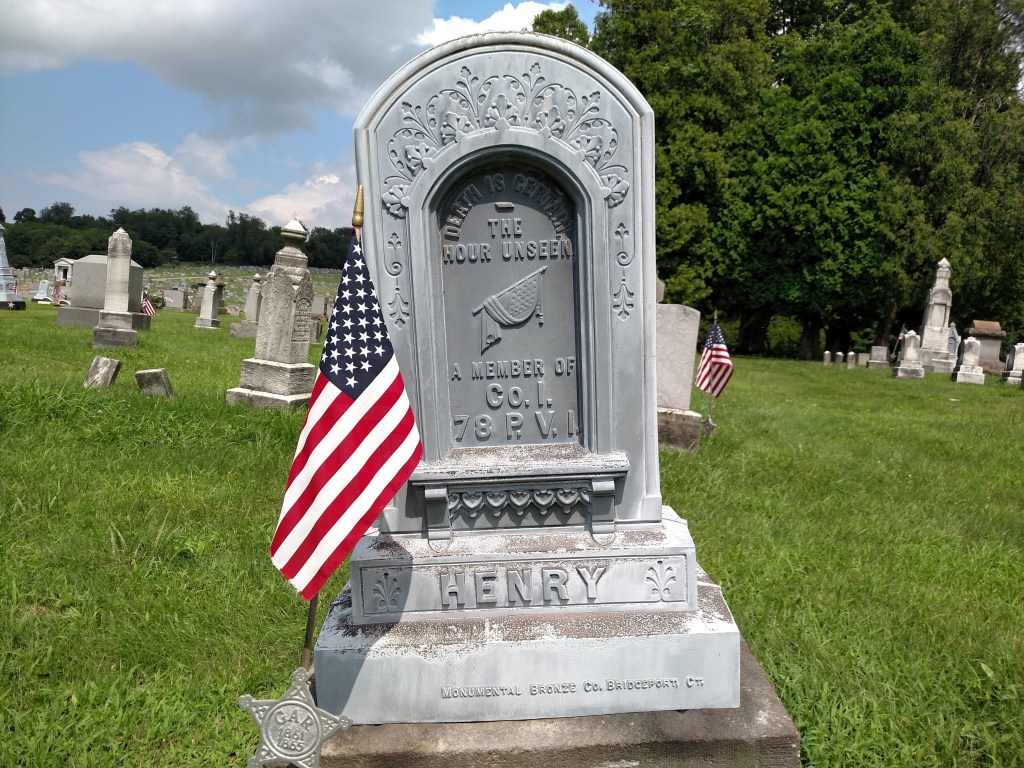
Image shows the front and back of Civil War veteran William Henry Henry’s prominent bronze-covered marker in the old Apollo cemetery. He died in 1882. His widow Mary Jane (Truby) Henry died about 10 years later, but it’s not clear where she is buried, and I can’t find specifics about her death. It’s possible that she’s buried next to her husband, but without a grave stone. The back of William Henry’s grave marker reads: Death is certain, The hour unseen. Incidentally, William Henry Henry was a half-brother of Thomas J Henry, who wrote the locally famous Apollo history book The Year of a Hundred Years, published in 1916 in recognition of the town’s 100th anniversary. Photos by Vicki Contie, 2017
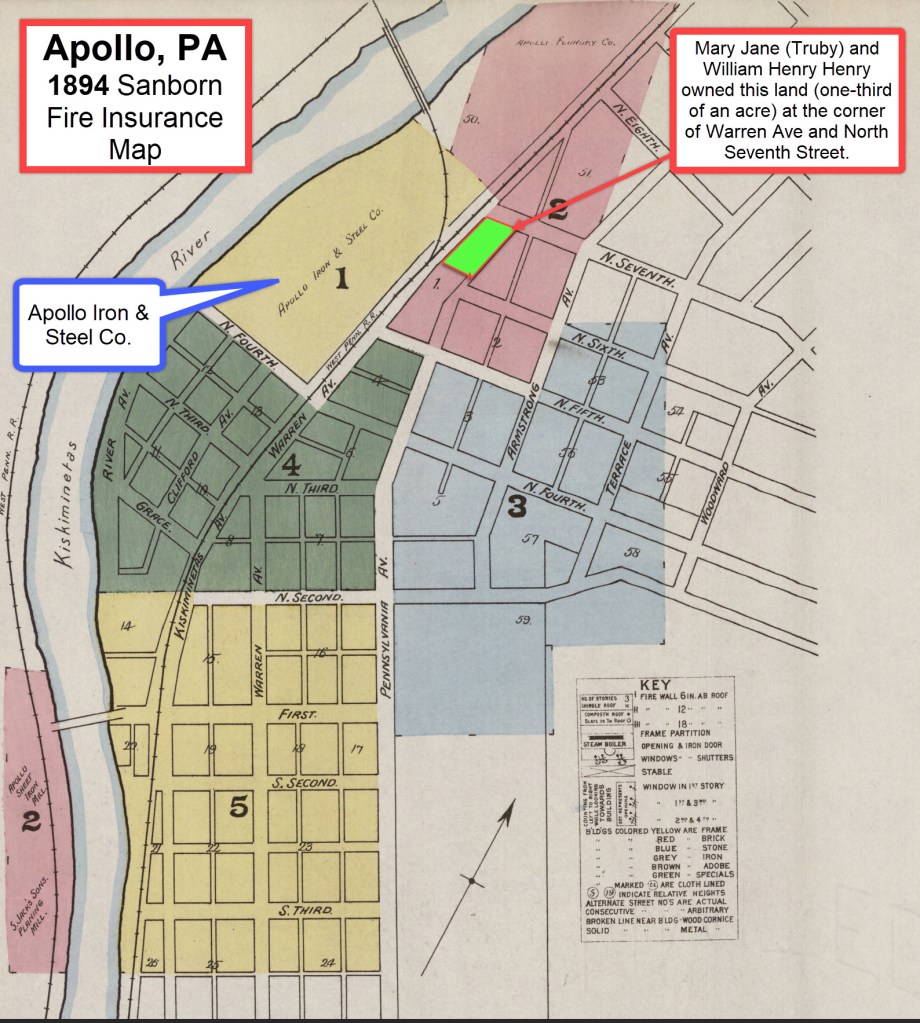
Court records show that at his death, William Henry Henry left behind no will, and he had few personal assets. However, he and Mary Jane Henry did own one-third of an acre in Apollo at the foot of North Seventh Street (then called Second Street), purchased years earlier from her father Simon Truby. Still, the court noted Henry’s assets were “not sufficient” for maintaining and educating the four minor children.
To help cover expenses, widow Mary Jane Henry sold a vacant portion of their Apollo property on April 13, 1887, to a buyer who paid $400 cash, as mentioned in a previous blog post. But Mary Jane did not immediately register that sale at the Armstrong County Courthouse. Back then, it was somewhat common to postpone registering property sales, in part because travel to the distant courthouse could be difficult and the registration fees costly.
A couple years later, on March 13, 1889, Mary Jane Henry trekked to the Armstrong County Courthouse in Kittanning to formalize that land sale. The justice of the peace testified in writing that Mary Jane Henry was present at court, so we know that Mary Jane was still alive in early 1889. She was at the courthouse again in July 1889. But after that, records about widow Mary Jane Henry are scarce. By January 1892, we know she’s no longer alive, because during the settlement of her father’s estate, Mary Jane is not listed as a beneficiary, but her four children are.
I wish I could learn more about Mary Jane (Truby) Henry, including where she is buried. If I ever do, I will let you know.
Harry T Henry: The responsible son
Mary Jane Henry’s eldest son (and Simon Truby’s eldest grandson) is easier to track. With his father gone, Harry T Henry took on new and daunting responsibilities, way beyond what most teenagers need to handle.
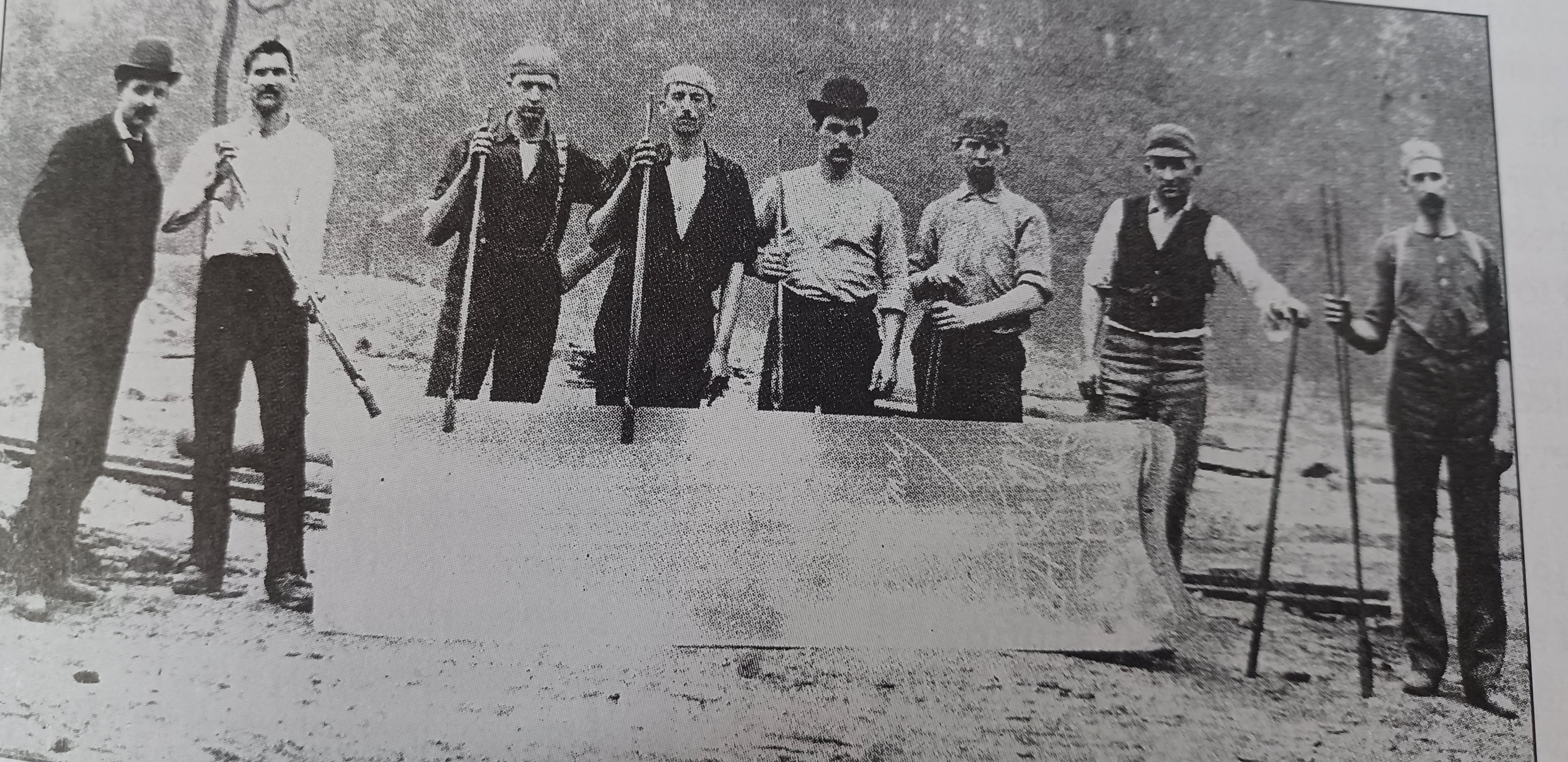
At age 16 he got a job at the Apollo Iron and Steel Company, just across the road from the Henry family home at the corner of Warren Ave and North Seventh Street in Apollo. Harry T Henry worked first as a scrap boy, gathering and sorting discarded metal fragments on the mill floor. He then took on increasing responsibilities and job titles until he ultimately became a roller like his father, according to Boucher’s History of Westmoreland County
Then, just four years after his father’s suicide came another significant death. Harry T Henry’s grandfather—Apollo farmer Simon Truby—died at age 79, on May 19, 1886.
So Harry T Henry, now 21 years old, stepped up to help his mom manage legal affairs related to the deaths of both his father and his grandfather. Harry’s age was fortunate. At 21 he was now old enough to be legal guardian for his two minor siblings, 15-year-old Ada and 5-year-old Willie. Although their mom Mary Jane Henry was still alive, women were considered unfit to handle the legal interests of minors, even their own children. Only males were deemed suitable to serve as legal guardians.
As legal guardian, Harry T Henry OK’d the marriage of his younger brother in 1902. And in 1905 he oversaw two more land sales that divided the original Henry property into three chunks. Two sisters—Amy J and Mary C Ralston—purchased the Henry family dwelling on North 7th Street. Another portion of land went to Mrs Anna E Kinter, whose husband, a Civil War veteran, was terminally ill at the time. These sales meant that this branch of the Henry family no longer directly owned land in Apollo.
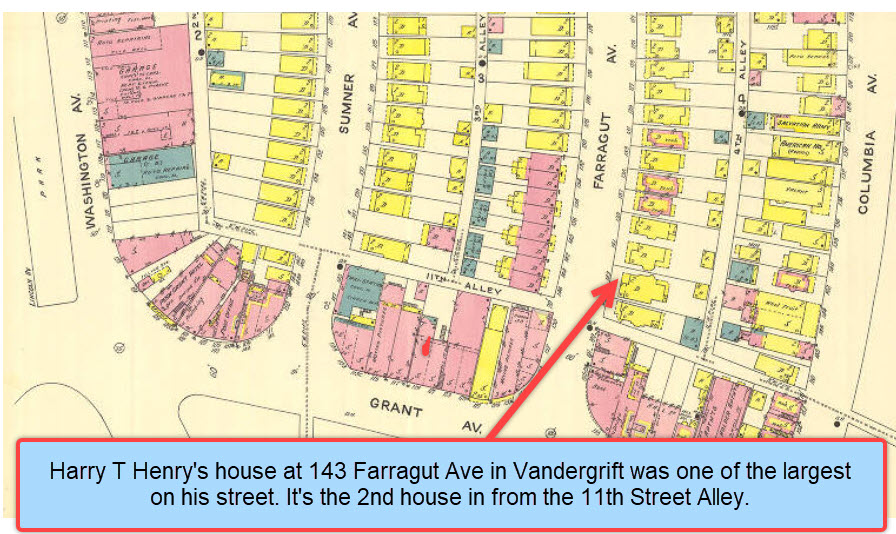
Beyond managing the sale of inherited properties, Harry T Henry was creating a family of his own. In April 1890, at age 24, he married Lydia Emma Horne (1864-1923) of Apollo. And by 1898 the couple had moved to the new and growing town of Vandergrift founded in 1895 as a “workingman’s paradise.” In fact, Harry T Henry was a first-day property-buyer in the new town, purchasing the lot at 143 Farragut Ave on the first day of land sales. He also served on the inaugural rolling crew at the new Apollo Iron and Steel mill in Vandergrift, located a couple of miles from Apollo, on the other side of the Kiskiminetas River.
By 1900, census records show that Harry T and Lydia Henry were living at 143 Farragut Ave in Vandergrift. They had four children: 8-year-old daughter Mary E Henry (1891-1982), 6-year-old Harry T Henry Jr (1893-1969), 4-year-old Joseph C Henry (1896-1982), and 1-year-old Gertrude (1898-1965), who later married Joseph Owens of Apollo. Another son, Theodore (Teddy) would come along later (1903-1953).
By 1910, Harry T Henry was able to pay off his mortgage. He went on to serve on the Vandergrift town council and school board. Harry T Henry also became a member of the First Methodist Church in Vandergrift, the Kiski Valley Steelworkers Association, and a life member of the Apollo Elks. His life seemed to be on an upswing. But upswings never seem to last.
By 1920, all but one of Harry T Henry’s children had married and moved out of the family house. Only 23-year-old Teddy was still at home. With so much unoccupied space in the house, Harry T Henry and his wife Lydia took in a boarder—46-year-old Theodore Beihl, a merchant in a clothing store. This might hint at financial difficulties. Or it might simply be kind generosity.
Three years later, in 1923, Harry T Henry’s wife Lydia (Horne) Henry passed away at age 61. Funeral services were held at their home, 143 Farragut Ave in Vandergrift.
Harry T Henry remarried a few years after Lydia’s death. He courted a Swiss immigrant named Eda Schmid, who had been living at the other end of Farragut Ave for about 2 decades. Eda was about 12 years his junior.
Harry T and Eda Henry continued to take in boarders through the 1920s and 30s. But by 1938, the couple sold their spacious family home on Farragut Ave to Harry’s son and namesake, Harry T Henry, Jr. Harry Jr seemed to need that large house on Farragut Ave. The 1940 census shows that Harry Jr’s household included four generations of family. This this was his 42-year-old wife Ruth Henry née Kunselman, their 25-year-old daughter Helen McGeary, Helen’s 2-year-old daughter Lynda, and Harry’s 70-year-old mother-in-law Anna Kunselman. A truly multi-generational living arrangement! (Harry T Henry Jr. was mentioned in the earlier blog post Black Hand and the Chicken Coop Caper).
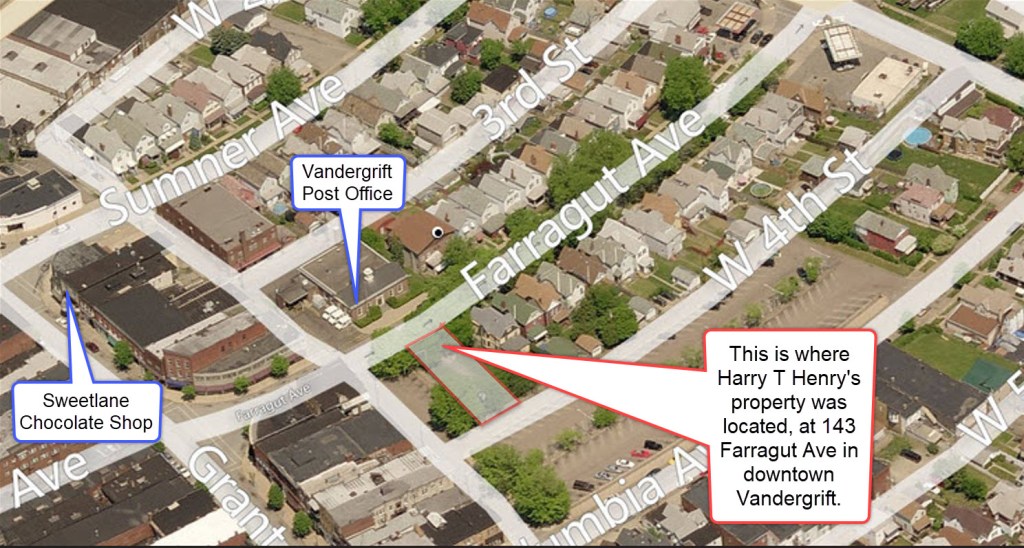
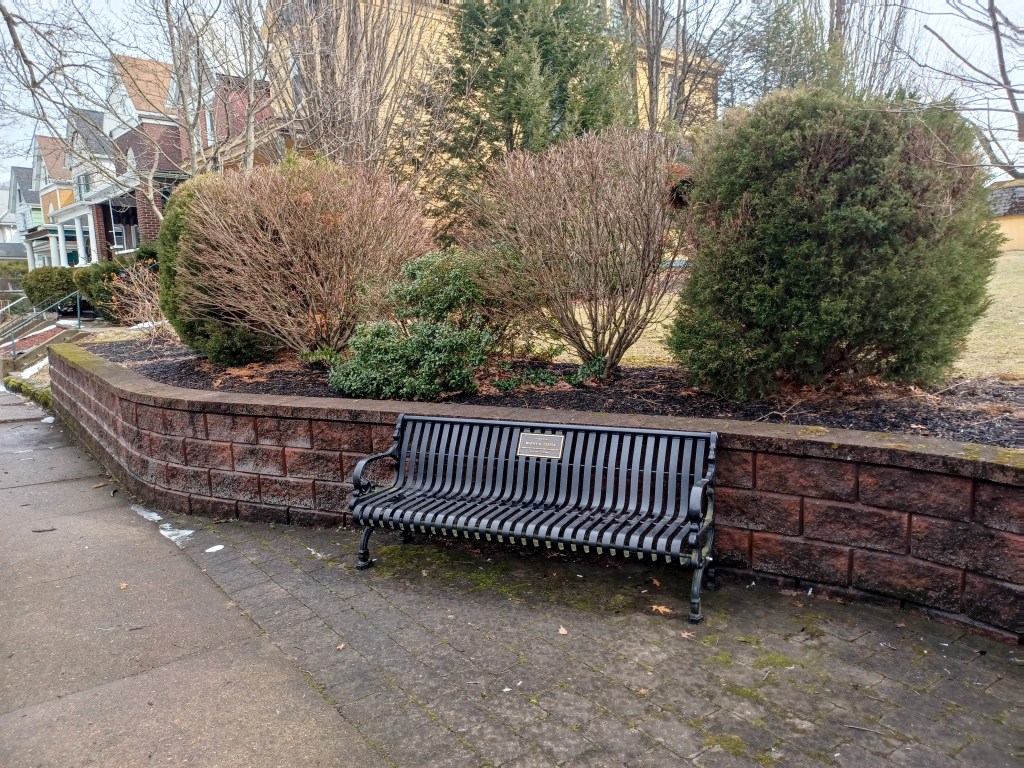
Sad to say, on a block that has many historic houses, the Henry house at 143 Farragut Ave no longer exists today, nor do the neighboring two houses. The former Henry house is now the site of the Wayne A Teeple Memorial Park, which honors a founder of the Vandergrift Improvement Program.
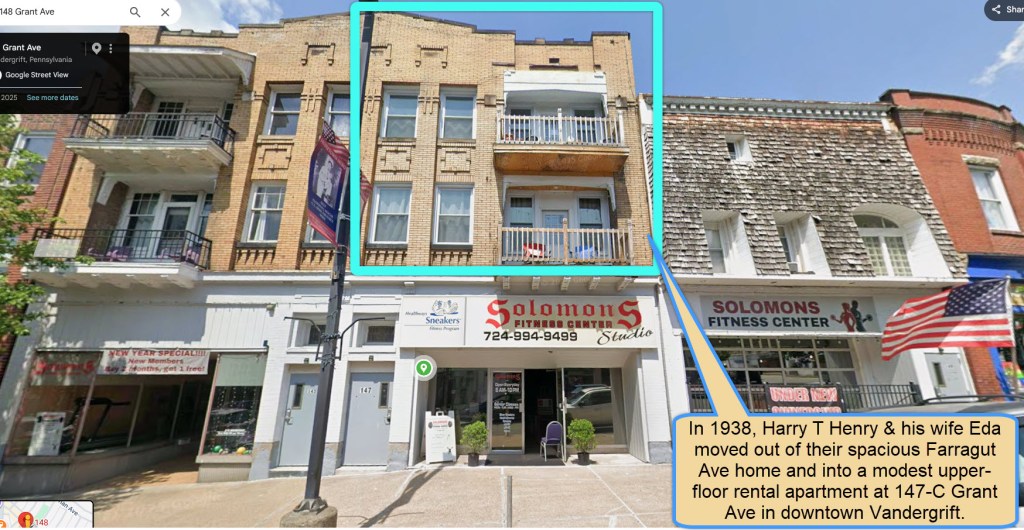
Meanwhile, once the elder Harry T Henry sold the large family home, he and his wife Eda moved into a smaller 2nd or 3rd floor rental apartment on Grant Avenue, the main business thoroughfare in Vandergrift.
By that time, Harry’s son Joseph C Henry was already living in a similar apartment across the street, at 148-H Grant Ave, along with his wife Gertrude and son Joe Jr. Joseph Sr lived in that apartment, on the west side of Grant Ave, for more than two decades. One of his relatives shared some fond childhood memories of that Grant Ave dwelling:
They had a small second floor apartment above a toy store. As a kid I always liked visiting…We could play on the flat roof, sit in the apartment and watch all the ‘action’ on Grant. In the evenings we would walk across the street to the ice cream shop. Good times.
That sounds so nice to me! I wonder if the ice cream shop might have been Islay’s? They had the best chipped ham, and of course delicious ice cream. Boy do I miss that!
Meanwhile, Harry T Henry Sr and Eda had moved into an apartment across the street, at 147-C Grant Ave, above today’s Solomons Fitness Center. (Is that where Islay’s used to be?)
Even in this modest dwelling, Harry T Henry and his wife Eda continued to take in a series of boarders who worked in the Vandergrift mill. About 15 years after moving in, Harry T Henry died in their Grant Ave apartment at age 87, on August 20, 1853. He had outlived all of his siblings.
About those siblings
The remaining three children of Mary Jane and William Henry Henry didn’t live well-documented public lives like their older brother Harry. So details about Bertha, Ada, and Willie Henry can be hard to track down. And some sources are just plain wrong (I’m talking to you, Boucher’s History of Westmoreland County). In a sense these three children are somewhat like their mom Mary Jane–tricky to trace and sort of forgotten. But I haven’t forgotten them.
Women in general before 1900 tended to leave behind only flimsy paper trails, which makes it hard to learn about their lives. And of course, those who die young often have little documentation for us to find. But I did some digging and found some interesting details. I’ll share what I’ve learned about Bertha, Ada, and Willie in my next blog post.
As always, if you love Kiski valley history, please consider contributing to your local historical society–whether as a volunteer or a financial supporter. Two of my faves are the Apollo Area Historical Society and the Victorian Vandergrift Museum and Historical Society.
Comments/feedback/corrections always welcome. Thank you for reading.
-Vicki Contie
© 2026 Vicki Contie
 Truby Farmhouse Apollo PA
YES it was Islays! I couldn’t remember the name! Thank youThomas HenryOn Sep 13, 2026,
LikeLike
Always enjoy your history lessons Vicki, thank you for sharing!
LikeLike
Vicki one quick note.
LikeLike